EN
EN  IT
IT 

From Paris to the future of our kids: what I take home from the IECA Symposium 2026
When I unpacked my suitcase upon my return from Paris, I realized that the heaviest bags were not the ones filled with notes and university brochures, but the ones loaded with reflections, perspectives, and new awareness.
As I told you in my Previous article on the reasons for my departure, I had embarked on this journey to the’IECA Symposium with a very specific set of questions in my mind. They are the same questions I hear every day in my practice: how will my child find his or her place in a world dominated by artificial intelligence? Or does it still make sense to make sacrifices for an international education when technology seems to be able to shorten every distance and automate every skill?
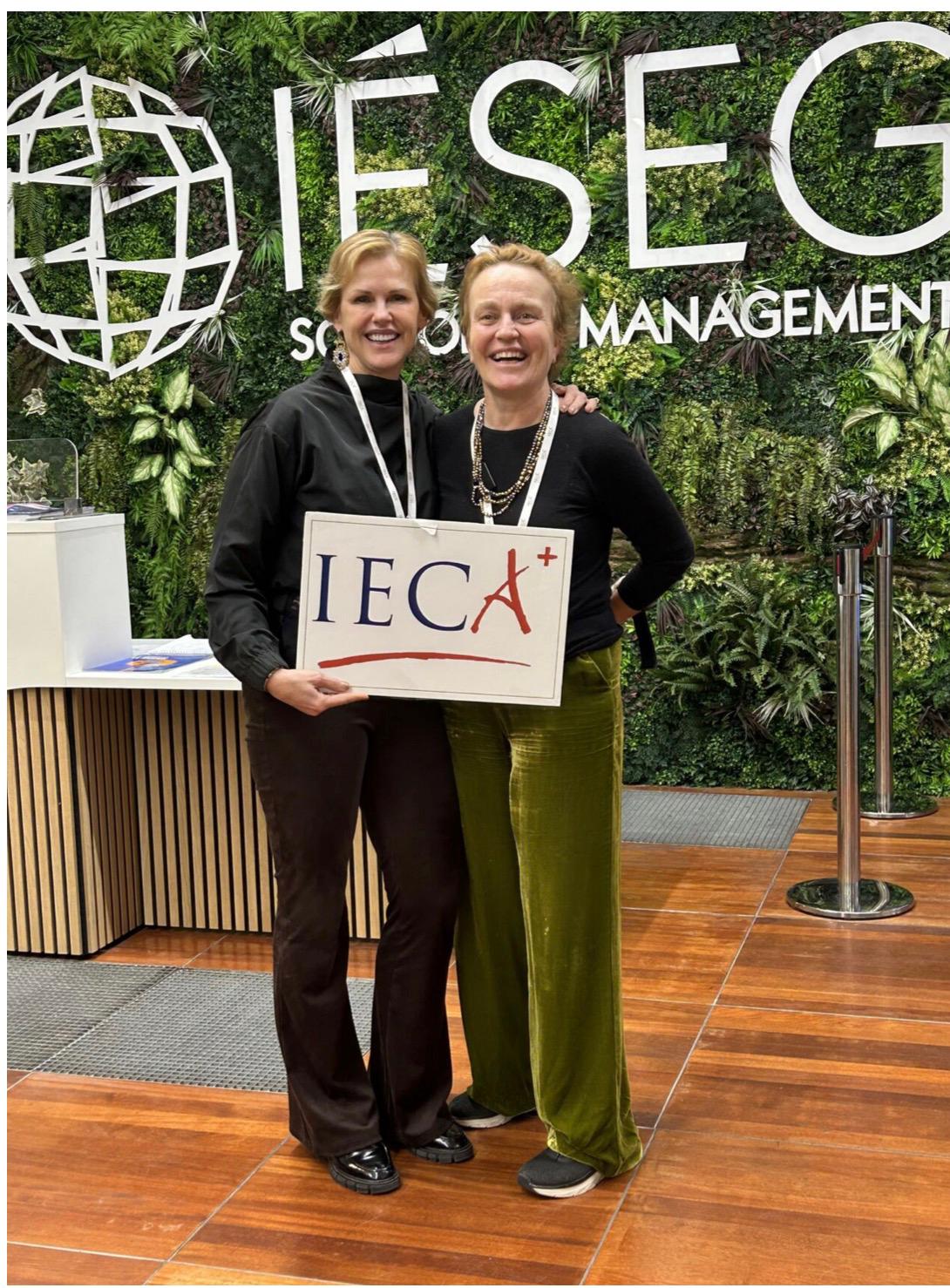
Today, after two days of intense discussions, panels and comparisons hosted in the modern and vibrant spaces of the IÉSEG School of Management, just beneath the imposing Grande Arche de La Défense, I return home with solid answers and a deep sense of gratitude.
Indeed, I must confess a particular pride: I did not experience these days only as a spectator. In the past months, as I had anticipated, I had the great privilege of working behind the scenes to shape the agenda of the’IECA Symposium, side by side with Andrea Tsahageas and an outstanding team of colleagues. Together, we built a program that focused on the real challenges of today: the impact of AI, global education, and the evolution of European university models. Seeing our incredible community come alive and engage with each other on these issues was the culmination of a long team effort.
In front of an auditorium packed with representatives from some 40 universities in Europe and the United States, along with some 80 independent educational consultants, we went through a real “transatlantic assessment” of the future of our kids. And I come back with a much clearer view of who the “Future Learner” really is today.
Artificial Intelligence is not the enemy, but a mirror of our humanity
How, then, to respond to this “structural erosion”? The answer cannot be a simple integration of AI into classrooms, but a real redesign. As Lapenta (John Cabot ) pointed out, when intelligence becomes widely accessible, institutions must consciously cultivate what remains scarce: the skills that AI can never reproduce or replace.
Echoing him, in one of the most exciting moments of the event, was Andreas Schleicher, Director of the Education and Skills Department and special adviser to the OECD Secretary-General.. Schleicher reminded us of a truth that technology often makes us forget: the best indicator of high-quality teaching is when students believe that their teacher would be genuinely happy Of seeing who they have become years later.
An algorithm will never be “happy” with our boy's achievements. It will not feel pride seeing him graduate, nor will it know how to instill courage in him after a failure. We human beings are and remain social animals: we learn through inspiration, emulation, collaboration and even that healthy competition in a college classroom. Only genuine human connection can fuel the true “appetite” for knowledge and turn a simple study period into the true journey of growth I wish for every student.
Beyond standardized tests: the true value of “Best Fit”.
Today's cutting-edge universities are not simply looking for “test machines” capable of memorizing notions on repeat. Instead, I look for students with real critical thinking, capable of grasping ethical nuances, working in international teams, and adapting to rapidly changing contexts.
This ties in perfectly with what I try to convey to families when we talk about study abroad in 2026: studying across borders is not just a medal to pin on your resume or a trick to jump the queue in the job market. It is a real gymnasium of life. It is an accelerator of those soft skills (human and soft skills) that will become the real discriminating factor when AI has automated most technical skills. An international experience teaches children to navigate uncertainty, understand cultures profoundly different from their own, and build a network of relationships that no machine can ever replicate.
The new role of counselors (and parents) in the AI era
As educational guidance professionals, our responsibility is undergoing a radical transformation, and so is the role of parents. What does this mean in daily practice? It means that we are no longer - and should no longer be - mere “information providers.” If a kid just wants a list of ten European universities with courses in English, today he only needs to type a prompt on ChatGPT. But artificial intelligence cannot read the anxiety in the eyes of an indecisive 17-year-old. It cannot interpret family dynamics, it cannot assess whether a city is too dispersed for a given student's character, and it certainly cannot build a tailored plan by paying attention to the Economic sustainability and to real costs that the family will face over the years.
To stay relevant, both as counselors and as parents, we need to take a step forward: we need to think deeper, ask better questions of our kids and provide invaluable value in which AI is completely lacking: human critical judgment, empathy, lived experience and deep connection.
Practical advice for families of the “Future Learner”
In light of all that emerged at the IECA Symposium, how can we translate these lofty reflections into concrete actions for those who are about to choose a college or university pathway abroad? Here are some solid points to build on:
- Seek interdisciplinarity: do not just look for ultra-specialized and purely technical courses (so-called “structured cognitive production,” which is in danger of soon being commodified by AI). Evaluate universities that allow contamination of knowledge (for example, combining economics and philosophy, or computer science and social sciences). Mental flexibility will be the winning weapon.
- Investigate the human side of the university: during Open Days (or on campus visits I organize), don't just ask what the occupancy rates are. Ask what the ratio of professors to students is. Ask if the professors know the students by name, if there are mentoring programs, and if real group work and ethical debate is encouraged, not just the delivery of written essays.
- Use AI as a stepping stone, not a crutch: Encourage your children to use artificial intelligence to do exploratory research on universities, but demand that the “why” they choose one destination over another comes from deep personal introspection, not from the algorithm.
Ready to begin this journey together
The incredible energy I breathed in Paris during this IECA Symposium, made even more special by the overwhelming enthusiasm of the IÉSEG students who acted as our “ambassadors” throughout the event (real professionals of the future!), filled me with optimism.
The “Future Learner” we used to talk about on the work tables is not a hypercompetitive, cold automaton. It is the boy or girl who sits in the chair of my study: sometimes frightened, often confused, but always the bearer of extraordinary dreams, aware that he or she must build a future-proof flexibility, developing purely human skills that technology can never take away.
If, as a family, you are considering embarking on this incredible study abroad pathway, my message to you is one: the education of the future is coming under tremendous structural pressure, but for that very reason our children will need schools and universities that are more humane than ever before. It will be a challenging journey, dense with crucial choices, but rich with satisfaction. And I am here, with my mind enriched by this new European background, ready to accompany you. Together, step by step, toward tomorrow.

Recent Posts
When I unpacked my suitcase upon my return from Paris, I realized that the heaviest luggage was not the one filled with notes and university brochures, but the one loaded with reflections, perspectives, and new awareness. As I told you in my previous article about the reasons for my departure, I had embarked on this journey to the IECA Symposium with a very specific set of questions in my mind. They are the same questions I hear every day in my practice: how will my son find his place in a world dominated by artificial intelligence? Or does it still make sense to make sacrifices for an international education when technology seems to be able to shorten every distance and automate every skill? Today, after two days of intense discussions, panels...

Summary When I talk to students and study abroad families, one question always comes back: how will school, university and work change in the age of artificial intelligence? In 2026, this question has become so central that I decided to help shape the scientific program of the IECA European Regional Symposium in Paris, dedicated to the "Future Learner." In this article I take you behind the scenes of these two days: why I chose to be there, who the Future Learner really is, and how AI can be an ally in study abroad choices. Not a technical account, but a compass for orientation. Why a symposium on the Future Learner (and why now) I well remember the moment I decided that the topic of the Future Learner would not...

Summary Every orientation journey is unique, made up of enthusiasms and second thoughts, fears to be faced and unexpected discoveries. In this article I tell the story of F., a student with an artistic soul who, through a months-long investigation, found her way into psychology in Berlin. A journey that involved not only her, but also her parents, who were called upon to transform anxiety into confidence. F.'s is just one of the many stories I accompany: each student has his or her own path, their own fears, their own revelations. But some dynamics are repeated, and sharing them can be helpful to those who are beginning this journey. When the creative soul meets psychology: a path of orientation through doubts, emotions and choices...

Summary As we prepare to close the doors on 2025, it is the perfect time to look ahead with renewed energy. The new year brings with it new academic programs, new competitions, and new challenges to embrace. In this end-of-year article, we take stock of what it really means to set yourself up for success in 2026-not only with up-to-date information on the best international university pathways, but with the same drive and dedication that has accompanied us so far. There is something symbolic about closing out a year. It is like turning the last page of an important chapter, with the knowledge that the next one is yet to be written. 2025 has been a busy year for so many families I have accompanied. We have explored...

Summary When a family decides to consider an international academic pathway, the question about financial investment and future return is inevitable and necessary. However, limiting the analysis to the first salary or the immediate prestige of the degree risks being a myopic view. In this in-depth analysis, we look at how the out-of-country study experience radically affects career prospects in the medium and long term. It is not just about enriching the resume, but about building a "future-proof" professionalism. We will see how change management, cultural adaptability and acquired method are the real keys to accessing the most ambitious professional opportunities in an ever-changing job market. The legitimate investment doubt: is it worth it? In my...

Summary A journey into the heart of German academic excellence, from Munich to Berlin via Karlsruhe. This is not just a diary of a college tour, but a real immersion into the future of higher education. In this article we take you with us to discover three cities and their universities, each with a unique soul: the pulsating innovation of Munich, the depth of research in Karlsruhe, and the creative energy of Berlin. A journey designed for those who have to choose a university in Germany and are looking for guidance beyond brochures, based on direct experience and a deep understanding of what each campus can offer. Our journey for you: a tour for choosing a university in Germany 1. Our mission: to be...

Summary This article offers a comprehensive guide for students beginning a study abroad journey, emphasizing how building connections is critical to a successful experience. The text takes students through the different stages of their journey, starting with the steps to take before departure, such as using university social media and actively participating in orientation for initial integration. Once at the destination, the article provides concrete tactics for creating a social network, suggesting keeping the dorm door open, forming study groups and joining student clubs. Academically, the guide explains how to navigate the new system, interacting with professors, taking advantage of campus resources, and adapting to a...

Summary As an educational counselor, I emphasize the importance of taking advantage of downtime to find one's college best fit through strategies of self-reflection, active research, and planning. The post explores practical methods for orientation: from creating a "passion journal" to campus visits, from building an academic profile to the supportive role of parents. The goal is to guide students toward an informed choice that goes beyond prestige, prioritizing alignment with their personal and professional aspirations. As an educational counselor who specializes in guiding students toward college pathways abroad, I observe each year the transformative potential of break times to identify one's academic best fit. Although August is drawing to a close, this period can still represent a valuable opportunity...

Every time I prepare a young person for his or her first departure, I find myself reliving the same question: what does it mean, today, to leave home to study across borders? In this post I gather some reflections born from the last chapter of my book and from my daily experience as an educational counselor: an integrated look at the emotions, practical challenges and potential of a path that, despite the uncertainties of the present, remains an extraordinary resource for young people and their families. Studying abroad in the age of global uncertainties Does studying abroad require courage? Certainly, it can be a challenge for kids and families, especially at a time in history fraught with questions for the younger generation. Yet it remains a unique opportunity. A choice of presence, not escape When I started...

In my work as an educational counselor, I dedicate myself with passion and deep responsibility to accompanying students on their college choice journey, visiting universities very often. It is not just a professional task, but a real mission: to help them navigate one of the most significant and transformative moments of their lives. This is an exciting journey, but a delicate one at the same time, as it involves guiding them not only to find their academic path, but to discover their most authentic passions, their hidden talents, and to envision how to turn this into a future full of possibilities, fulfillment and success. I firmly believe that the choice of college is a crucial moment in the life of a...


An international approach is critical to successfully meeting the challenges of the future. (altro…)
Studying abroad is much more than attending a university in another country. (altro…)

One of the first questions students and parents ask is just that: but how much does it cost to study abroad? (altro…)

What to know, how to choose, how to prepare for college abroad. All in a Book! A growing trend that has more than doubled in the last 10 years. A transformation that confirms the mental "quantum leap" that the very young Italians of Generation Z have matured in recent years, conceiving themselves more and more as "citizens of the world." Training abroad is a life-changing choice, an investment in one's future both personally and professionally, a path that opens up new perspectives in an ever-changing world. For these reasons it is a choice that ignites enthusiasm but nevertheless should be pondered with great realism and pragmatism:What is the right college for me? How much does it cost? How can I best prepare myself for admission? Is it from.

Katja Iuorio Educational Consulting's guide to grasping the best from the summer months is back! Summer 2021 promises to finally be more "normal" than last summer despite the fact that the environment is still eventful and in some respects uncertain. Amid all the unknowns, however, there is one idea that guides us: the summer period is the optimal opportunity to seize new opportunities and thus be able to think about future scenarios! Spending your summer learning a new skill or doing research is the best way to propel yourself forward without the stress of impending deadlines. We have selected a few courses for youCourses that, according to their subject areas, deepen skills and prepare you for a future study abroad trip Below is the...

Updates for those who are studying (or would like!) to study in the UK. Having averted the risk of a "No Deal," an agreement has been reached that will regulate relations with Europe in several areas, including study. Agreement that includes, among other things, rising fees and an exit from the Erasmus program. There are currently 14 thousand Italian students attending universities in the United Kingdom, corresponding to about one-tenth of European students.Europeans who will become international students on a par with any other nationality as of September 2021 and will therefore have to pay higher university fees-double and in some cases triple the current fees of £9,250 per year, which was guaranteed. Even the possibility of working in...

Summer is coming and with it many unmissable possibilities! Reasoning about one's future during a time of calm and relaxation like summer is the best thing to do to make well-thought-out and incisive choices. This will be a peculiar, anomalous summer to say the least: the vast majority of "pre-college" experiences, "summer schools" and "summer camps" will unfortunately be skipping.Nothing is lost though! I have carefully selected for you a number of courseswhich, depending on your major, can deepen your skills and can prepare you for a future study abroad trip.These are all experiences that I recommend because they are well structured and designed, use state-of-the-art techniques, and will also allow you to meet and interact with many foreign students. From Yale to Stanford, from Marketing...

In the true sense of the word. A fundamental experience that fully involves the whole family. A few days ago, reading an American article on this subject, I was reflecting on the importance of the counselor in guidance and decision-making at the college choice stage, and I thought that the reflections that came out of it might be interesting for you as well. It is indeed, for kids and parents, a choice that involves both emotionally and financially, and it is a fact that education represents the second largest item of expenditure in a family's life (after buying a house) and like the latter, lasts for many years. In addition to being a crucial choice for the future of children, precisely because it is long-term, it must be...

These are my key words these days. As this article from The Nation recounts (from the Student Nation column, written by students for students) due to the COVID-19 emergency many campuses closed overnight, without there being a coordinated plan among the different universities. This created a lot of chaos and many international students found themselves with nowhere to go and left to their own devices. My key words for this period are calm, clarity and communication. In the work of a Counselor, there are delicate situations to handle at this time such as students who are abroad, those who are applying for college in these weeks, and still others who had to leave for...