EN
EN  IT
IT 

Studying abroad: how much does it really cost and what is the return on investment? USA-Europe comparison guide
Summary
Studying in the United States today costs between 80,000 and 90,000 dollars per year, while in Europe many public universities c In this guide I compare the American university model with the European one on three concrete fronts: the real costs, the bureaucratic visa protections and the ROI long-term. You will also find practical advice on planning the family budget and answers to the most frequently asked questions from parents and students.
In my office, between the dreams of the kids and the choices of the families
In my educational counselor job I meet parents and teenagers every day who are grappling with one of the most important decisions of their lives: choosing a university. Some arrive with clear ideas while others show up with a thousand doubts, but in most interviews, the same question always comes up: does it still make sense to make enormous sacrifices to study in the United States, or are there better alternatives?
Until a few years ago, the answer seemed obvious. In the collective imagination, the “American dream” was the gold standard: if a young person had talent, the natural destination was Ivy League universities or major research campuses, and that brand on their resume was seen as the key to a global career. Continental Europe, in this scenario, remained relegated to the role of plan B, good for those who didn't want to stray too far from home.
Today the perspective has changed. Both parents and young people evaluate options in a more pragmatic way, looking less at prestige itself and much more at reality Return on Investment (ROI) academic and personal.
Giving a scientific basis to this change is recent research by the Center for Studies in Higher Education (CSHE) at UC Berkeley, titled “Divergent Business Models in International Higher Education: A Transatlantic Comparison”. The study, conducted by Prof. Michele Meoli of the University of Bergamo together with co-authors David B. Audretsch, Alice Civera, and Stefano Paleari, confirms that this transition is not a passing fad, but a strategic choice which is redesigning the map of international mobility for families and young people.
United States: the burden of staggering tuition fees and the myth of the ‘campus life’
How much does it cost today to study in the United States? Between tuition, room, and board, you exceed $80,000-$90,000 per year, for a total of nearly $350,000 over the entire course of studies. An enormous financial commitment, which in the USA falls almost entirely on families, given that university is conceived as a private asset. From the 1960s to today, the average cost of a college degree has more than tripled in real terms.
Until recently, this effort was accepted in exchange for a certainty: the ‘wage premium‘, meaning significantly higher post-graduate salaries for those who graduated in the United States. Today that differential is shrinking, and with it the equation that for decades justified the expense.
There is also another element to consider: the’hyperinflation of the costs related to campus life. A New York Times investigation summarized it with a direct headline: ‘College is worth the expense, but campus life is not.’ Many American universities have invested colossal sums in non-academic services, inflating tuition without a corresponding increase in teaching quality. And after all, kids aren't looking for a holiday village: they are looking for transferable skills and relationships, without having to mortgage one's future to obtain them.
The bureaucracy that dampens enthusiasm: the uncertainty of American visas
Is the American student visa risky today? The data says yes: at the beginning of 2025 there was a decline in 61% of global interest in specialization programs in the United States, according to research by Professor Meoli conducted for the Center for Studies in Higher Education (CSHE) at UC Berkeley.
When planning a study abroad program, the certainty of being able to complete it without sudden bureaucratic hurdles is essential. In recent years, however, the American student visa system has become increasingly uncertain. A concrete example is the reform proposals to eliminate the “Duration of Status”(D/S) for F-1 visas: this status allowed staying in the USA for the entire duration of studies without continuous renewals. Replacing it with rigid deadlines introduces a level of anxiety that many families do not want, or cannot, afford, and adds to the already existing restrictions on post-graduation work (OPT).
The result is that young people and their families no longer perceive America as a welcoming country for those who want to study. The fear of investing enormous resources only to be forced to leave the country because of a bureaucratic technicality is pushing more and more people to look at Europe, which offers pathways more linear, stable and secure.
Continental Europe: a value strategy, not a fallback
As Professor Meoli explained in a recent conversation with the European IECA group, the most fitting comparison is precisely with aviation: European universities today behave like the early low-cost airlines. They have eroded the market dominance of the major legacy carriers (the elite American universities) not by offering less, but by offering differently, at a price that more and more people find sensible.
How much does it cost to study in Europe compared to the United States? Much less: in Germany Public universities are free for EU citizens, whereas in countries like the Netherlands or Italy, annual tuition fees average between 1,000 and 3,000 euros. In other words, a young person's entire university education in Europe can cost less than a single month at an American college. And this is not a compromise on quality: unlike the United States, where the gap between elite universities and mid-tier colleges is enormous, the European system guarantees uniform and excellent academic standards everywhere.
Then there is a factor that changed the rules of the game: the explosion of programs in English, the so-called English-Taught Programs. In 2009, there were only 55 bachelor's degree programs taught in English throughout continental Europe; today there are over 3.000. The language barrier has effectively fallen: young people can study in English in the Netherlands (which has become a true international hub), in Germany, in Denmark, or in Italy, in a cosmopolitan environment that combines study with cultural openness. This combination of quality and economic sustainability now also attracts American students, about 300,000 each year.
Financial planning: my 5-step practical guide for families and students
In my work as a counselor, I always repeat the same thing: a good financial planning is the key to experiencing study abroad with peace of mind. Families often focus only on the cost of tuition fees, overlooking a series of collateral expenses that can weigh heavily on the budget. Here are 5 steps which I always advise following.
- Divide the expenses into categories. Carefully calculate the cost of accommodation, which in cities like Amsterdam or Munich is high and must be booked well in advance, then food, local transportation, trips home during holidays, and mandatory health insurance. A detailed list, made before departure, avoids unpleasant surprises midway through the year.
- Do not underestimate scholarships and financial aid. Many European universities offer them, based both on academic merit and on the family's financial situation. Then there are calls for applications from the Ministry of Foreign Affairs or private foundations: they need to be looked for calmly, and the search should start at least 12 months before departure.
- Seriously consider the part-time work option. In Europe, EU students can work without any legal restrictions, and even for non-EU students, the rules are simple—usually up to 20 hours a week. In the United States, however, the F-1 visa almost completely prohibits off-campus work: one less opportunity for those who want to become financially independent.
- Take advantage of the student discounts. Public transport, museums, cinemas, and even many restaurants offer significant discounts with a student ID. It might seem like a small detail, but teaching kids to use it systematically really helps optimize the daily budget.
- Watch out for currency exchange management. If you study in a country outside the euro area, such as the United Kingdom or Switzerland, it is advisable to open a local multi-currency account: otherwise, bank fees on withdrawals and card payments will silently erode your funds, month after month.
Beyond the educational qualification: “Power Skills” and the real value of experience
A European degree is worth as much as an American degree in the labor marketYes, and the reason is simple: the true value does not lie in the prestige of the university, but in the development of “Power Skills”—those transversal competencies that artificial intelligence cannot automate and that recruiters persistently look for.
The first is the ability to problem solving in different contexts. Studying in a different academic system, such as the Dutch one based on teamwork and a practical approach, forces young people to break out of the mental tracks they are used to. Learning to collaborate with people from different cultures builds a cognitive flexibility that they then carry everywhere, even into the workplace.
Then there is the’cultural intelligence, which goes hand in hand with empathy. Working in an international team forces you to develop an acute relational sensitivity: you learn to negotiate, to mediate, to read between the lines and to overcome prejudices almost without realizing it. In modern companies, globalized by nature, this sensitivity has become an asset that truly makes a difference.
Finally there is the’independence, which over time transforms into everyday resilience. Living far from home, managing the bureaucracy of another country, administering a budget, and solving minor unexpected problems without the immediate help of parents is a life gym that has no equivalent in the classroom. Young people mature sooner, acquire self-confidence, and arrive ready to face challenges with an extra gear.
This comprehensive and dynamic profile makes graduates with international experience ideal candidates for multinational graduate programs or roles in innovative start-ups. The initial investment pays off not only professionally, but above all in personal development, offering lifelong career freedom and flexibility.
Frequently asked questions about the costs of studying abroad
Is studying abroad an opportunity reserved only for families with significant financial resources?
No, not necessarily. Many European countries, such as Germany or the Netherlands, offer excellent education at little to no cost. Added to this are merit- or need-based scholarships, which make the path accessible to a much larger number of families than people think.
Are academic degrees earned in Europe recognized in Italy and abroad?
Yes, they are fully recognized. Thanks to the Bologna Process and the ECTS credit system, degrees awarded by universities in participating countries are comparable at a European and international level, which significantly simplifies professional and academic mobility after graduation.
When is the best time to start planning the application?
The ideal time is during your junior or senior year of high school. This timeframe allows you to take your time choosing your target countries, check language requirements, prepare the necessary certifications, and build a really competitive profileo.
Is it possible to work to support oneself while studying abroad?
Yes, especially in Europe, where the procedures are simpler than in the United States. EU students have no hourly limits, while non-EU students are generally subject to a cap of 20 hours per week during the academic term, which often becomes unlimited during the summer months. In the United States, the situation is much stricter: the F-1 visa allows students to work almost exclusively on campus, making it virtually impossible to find off-campus employment to supplement the family budget.
The right path for your future
And in a world changing at this speed, accessibility and certainty of rules have become the new, true prestige. Today, the challenge for families and those involved in guidance is no longer simply chasing the most high-sounding university brand. It is about knowing how to read real data to build tailored, flexible, and sustainable paths. Because the true value of higher education today is not measured by the starting cost, but by the freedom of choice and the concrete return it leaves for the future of young people.
If you are evaluating the cost of studying abroad and would like to build together a custom map, that takes into account the kids' inclinations, admission requirements, and the family budget, write to me: I am here for this.
Planning ahead is the first step of a journey truly worth building impeccably, one that is not limited to an academic degree, but translates into real and tangible opportunities for a lifetime.

Recent Posts

Summary Studying in the United States today costs between $80,000 and $90,000 per year, whereas in Europe many public universities C In this guide, I compare the American university model with the European one across three concrete fronts: real costs, bureaucratic visa protections, and long-term ROI. You will also find practical advice for planning family budgets and answers to the most frequent questions from parents and students. In my office, between students' dreams and families' choices In my work as an educational counselor, I meet parents and young people every day grappling with one of the most important decisions of their lives: choosing a university. Some arrive with clear ideas already, while others show up...

Summary In this guide, we will explore how to transform the summer months into a strategic resource for applying to universities abroad. We will analyze: How to build a competitive profile ('Career Capital') without resorting to formal internships. How to select target countries critically among the Netherlands, Germany, the United Kingdom, and Ireland. The technical management of application portals (UCAS, CAO, Studielink, Uni-assist). A clear month-by-month roadmap from July to September. Every year, around September, I receive dozens of calls that almost always begin the same way: "We discovered all the deadlines for applying to universities abroad too late." During the summer, while school is out, time seems to stretch, and the idea of thinking about university feels distant. Then September arrives: the...
On July 10th, I will be a guest at H-FARM to lead the workshop "Your Path." This is a special session designed for a group of 15 teenagers, aged 16 to 18, who are concluding an intensive week of training, sports, and personal growth. As I finalize the agenda and review the slide deck we'll use throughout the day, I find myself reflecting on a question I hear repeatedly in my office, especially from parents: "What is the right path?" It's a legitimate question, full of expectations and often, a good dose of anxiety. But the truth is, when it comes to the future and university, there isn't just ONE right path...
Summary For years, I have guided Italian students who wished to pursue their university education outside of Italy. This time, however, the perspective has flipped, and this is precisely what made the experience so interesting. Working as the Italy Country Expert for Briteguides, I found myself taking the opposite path: describing Italy, its university system, its opportunities, and even its complexities, to international students, families, and counselors who view my country as a potential study destination. This change in direction has made me reflect on a point I consider central to my work: studying abroad doesn't just mean moving geographically, but entering into a new relationship with the world, with others, and with oneself. In...

Summary The article emphasizes the crucial importance of timing in the university abroad journey, explaining that the right time to start is often sooner than one might think. Planning ideally begins before high school, with "sowing before reaping," focusing on building a solid profile and language skills. The path concretely takes shape in the third year (or equivalent), a time to begin exploring university systems and consider initial guidance counseling. The second-to-last year is defined as the "heart of planning," the year to initiate the full orientation process, define the budget, work on the extracurricular profile, and prepare for standardized tests. Finally, the last year is for applications, with crucial deadlines extending from October to March. The guide also addresses...
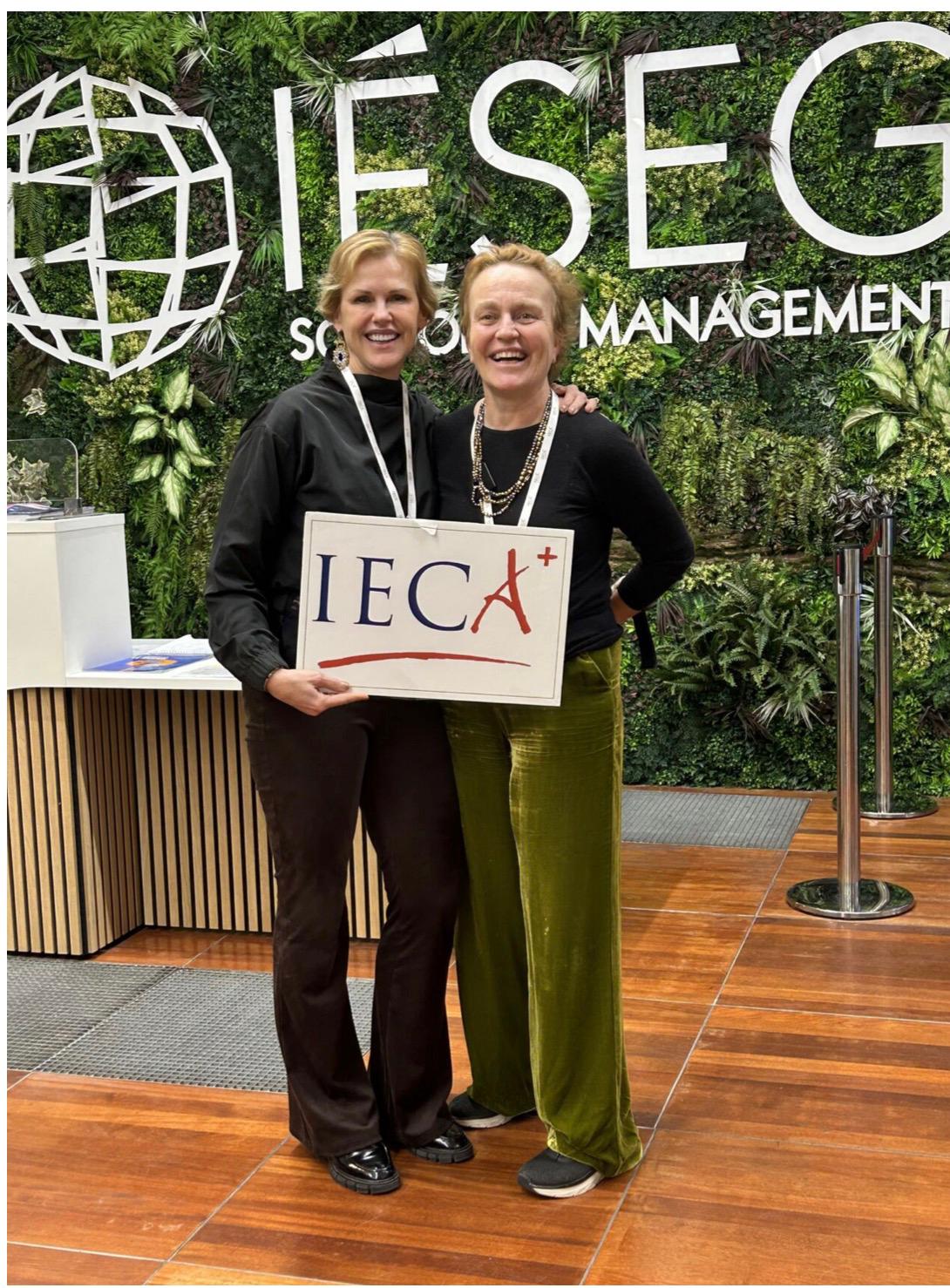
When I unpacked my suitcase upon my return from Paris, I realized that the heaviest luggage was not the one filled with notes and university brochures, but the one loaded with reflections, perspectives, and new awareness. As I told you in my previous article about the reasons for my departure, I had embarked on this journey to the IECA Symposium with a very specific set of questions in my mind. They are the same questions I hear every day in my practice: how will my son find his place in a world dominated by artificial intelligence? Or does it still make sense to make sacrifices for an international education when technology seems to be able to shorten every distance and automate every skill? Today, after two days of intense discussions, panels...

Summary When I talk to students and study abroad families, one question always comes back: how will school, university and work change in the age of artificial intelligence? In 2026, this question has become so central that I decided to help shape the scientific program of the IECA European Regional Symposium in Paris, dedicated to the "Future Learner." In this article I take you behind the scenes of these two days: why I chose to be there, who the Future Learner really is, and how AI can be an ally in study abroad choices. Not a technical account, but a compass for orientation. Why a symposium on the Future Learner (and why now) I well remember the moment I decided that the topic of the Future Learner would not...

Summary Every orientation journey is unique, made up of enthusiasms and second thoughts, fears to be faced and unexpected discoveries. In this article I tell the story of F., a student with an artistic soul who, through a months-long investigation, found her way into psychology in Berlin. A journey that involved not only her, but also her parents, who were called upon to transform anxiety into confidence. F.'s is just one of the many stories I accompany: each student has his or her own path, their own fears, their own revelations. But some dynamics are repeated, and sharing them can be helpful to those who are beginning this journey. When the creative soul meets psychology: a path of orientation through doubts, emotions and choices...

Summary As we prepare to close the doors on 2025, it is the perfect time to look ahead with renewed energy. The new year brings with it new academic programs, new competitions, and new challenges to embrace. In this end-of-year article, we take stock of what it really means to set yourself up for success in 2026-not only with up-to-date information on the best international university pathways, but with the same drive and dedication that has accompanied us so far. There is something symbolic about closing out a year. It is like turning the last page of an important chapter, with the knowledge that the next one is yet to be written. 2025 has been a busy year for so many families I have accompanied. We have explored...

Summary When a family decides to consider an international academic pathway, the question about financial investment and future return is inevitable and necessary. However, limiting the analysis to the first salary or the immediate prestige of the degree risks being a myopic view. In this in-depth analysis, we look at how the out-of-country study experience radically affects career prospects in the medium and long term. It is not just about enriching the resume, but about building a "future-proof" professionalism. We will see how change management, cultural adaptability and acquired method are the real keys to accessing the most ambitious professional opportunities in an ever-changing job market. The legitimate investment doubt: is it worth it? In my...

Summary A journey into the heart of German academic excellence, from Munich to Berlin via Karlsruhe. This is not just a diary of a college tour, but a real immersion into the future of higher education. In this article we take you with us to discover three cities and their universities, each with a unique soul: the pulsating innovation of Munich, the depth of research in Karlsruhe, and the creative energy of Berlin. A journey designed for those who have to choose a university in Germany and are looking for guidance beyond brochures, based on direct experience and a deep understanding of what each campus can offer. Our journey for you: a tour for choosing a university in Germany 1. Our mission: to be...

Summary This article offers a comprehensive guide for students beginning a study abroad journey, emphasizing how building connections is critical to a successful experience. The text takes students through the different stages of their journey, starting with the steps to take before departure, such as using university social media and actively participating in orientation for initial integration. Once at the destination, the article provides concrete tactics for creating a social network, suggesting keeping the dorm door open, forming study groups and joining student clubs. Academically, the guide explains how to navigate the new system, interacting with professors, taking advantage of campus resources, and adapting to a...

Summary As an educational counselor, I emphasize the importance of taking advantage of downtime to find one's college best fit through strategies of self-reflection, active research, and planning. The post explores practical methods for orientation: from creating a "passion journal" to campus visits, from building an academic profile to the supportive role of parents. The goal is to guide students toward an informed choice that goes beyond prestige, prioritizing alignment with their personal and professional aspirations. As an educational counselor who specializes in guiding students toward college pathways abroad, I observe each year the transformative potential of break times to identify one's academic best fit. Although August is drawing to a close, this period can still represent a valuable opportunity...

Every time I prepare a young person for his or her first departure, I find myself reliving the same question: what does it mean, today, to leave home to study across borders? In this post I gather some reflections born from the last chapter of my book and from my daily experience as an educational counselor: an integrated look at the emotions, practical challenges and potential of a path that, despite the uncertainties of the present, remains an extraordinary resource for young people and their families. Studying abroad in the age of global uncertainties Does studying abroad require courage? Certainly, it can be a challenge for kids and families, especially at a time in history fraught with questions for the younger generation. Yet it remains a unique opportunity. A choice of presence, not escape When I started...

In my work as an educational counselor, I dedicate myself with passion and deep responsibility to accompanying students on their college choice journey, visiting universities very often. It is not just a professional task, but a real mission: to help them navigate one of the most significant and transformative moments of their lives. This is an exciting journey, but a delicate one at the same time, as it involves guiding them not only to find their academic path, but to discover their most authentic passions, their hidden talents, and to envision how to turn this into a future full of possibilities, fulfillment and success. I firmly believe that the choice of college is a crucial moment in the life of a...


An international approach is critical to successfully meeting the challenges of the future. (altro…)
Studying abroad is much more than attending a university in another country. (altro…)

One of the first questions students and parents ask is just that: but how much does it cost to study abroad? (altro…)

What to know, how to choose, how to prepare for college abroad. All in a Book! A growing trend that has more than doubled in the last 10 years. A transformation that confirms the mental "quantum leap" that the very young Italians of Generation Z have matured in recent years, conceiving themselves more and more as "citizens of the world." Training abroad is a life-changing choice, an investment in one's future both personally and professionally, a path that opens up new perspectives in an ever-changing world. For these reasons it is a choice that ignites enthusiasm but nevertheless should be pondered with great realism and pragmatism:What is the right college for me? How much does it cost? How can I best prepare myself for admission? Is it from.